
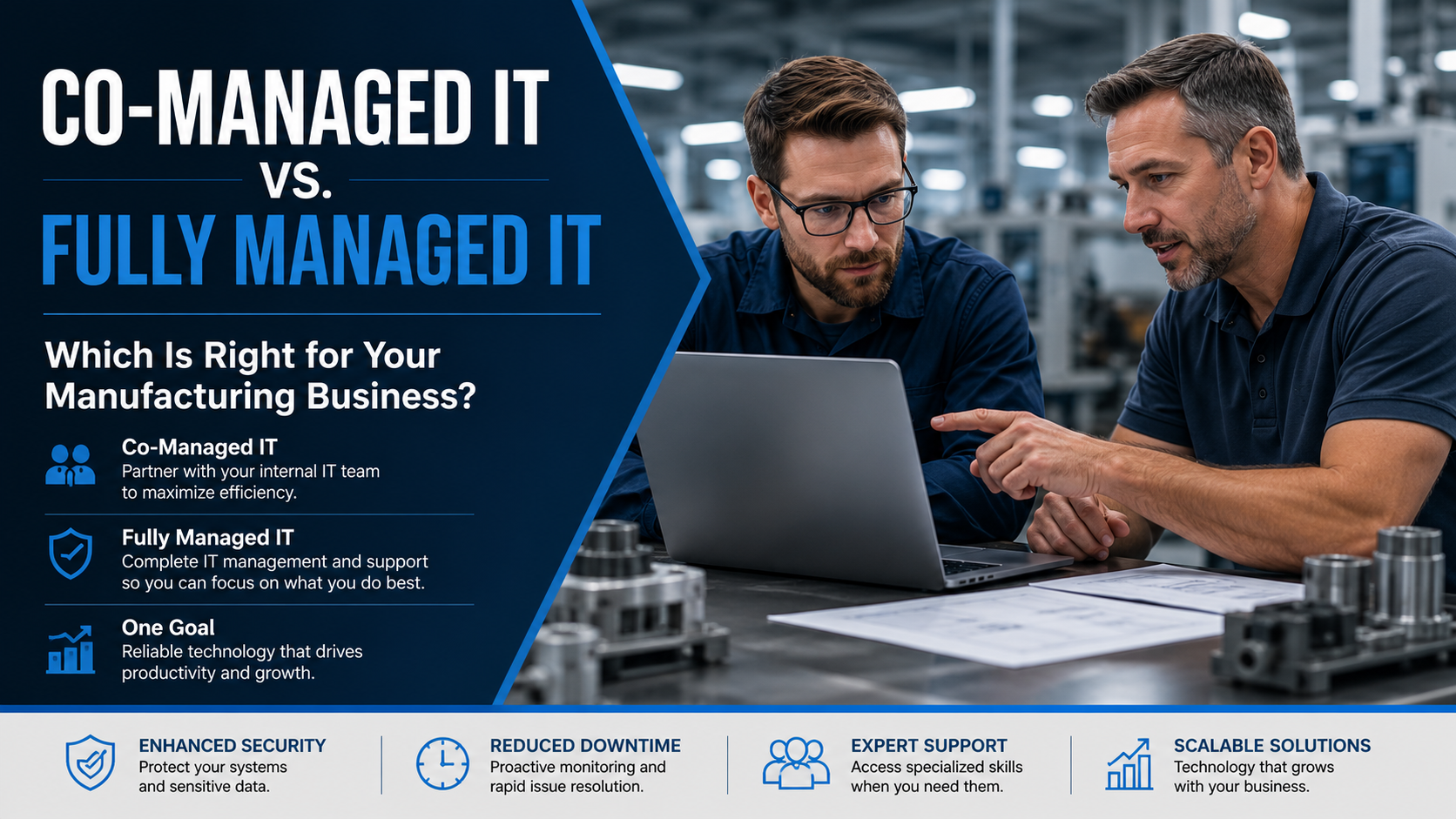
Technology has become one of the most important drivers of productivity in today’s manufacturing environment. From ERP systems and production equipment to cybersecurity and cloud collaboration, manufacturers depend on reliable IT infrastructure to keep operations moving.
Many manufacturers already have internal IT staff but find it increasingly difficult to keep up with cybersecurity threats, compliance requirements, infrastructure upgrades, and around-the-clock support. Others need a trusted partner to manage their entire technology environment.
This often leads to an important question:
Should your manufacturing company choose co-managed IT or fully managed IT?
Understanding the differences can help you select the right support model for your business today while preparing for future growth.
What Is Fully Managed IT?
Fully managed IT means outsourcing the day-to-day management of your technology environment to a Managed Service Provider (MSP).
The MSP becomes your primary IT department, handling responsibilities such as:
- Help desk support
- Network monitoring
- Cybersecurity
- Server and workstation management
- Microsoft 365 administration
- Backup and disaster recovery
- Strategic IT planning
- Vendor management
This model is ideal for organizations that do not have dedicated internal IT personnel or want a single partner responsible for their technology.
What Is Co-Managed IT?
Co-managed IT is a partnership between your internal IT staff and an experienced Managed Service Provider.
Instead of replacing your internal team, the MSP works alongside them by providing additional expertise, tools, and support where it’s needed most.
For example, your internal IT department may continue handling:
- Daily user support
- On-site troubleshooting
- Employee onboarding
- Equipment deployment
While your MSP manages:
- Advanced cybersecurity
- 24/7 monitoring
- Infrastructure maintenance
- Compliance support
- Cloud management
- Strategic technology planning
- Disaster recovery
This partnership allows internal teams to focus on business priorities while leveraging outside expertise for specialized services.
Why More Manufacturers Are Choosing Co-Managed IT
Manufacturing environments have become significantly more complex over the past several years.
Organizations now manage:
- Production systems
- ERP platforms
- Warehouse technology
- Remote employees
- Cloud applications
- Mobile devices
- Increasing cybersecurity threats
Expecting one or two internal IT professionals to manage every aspect of technology is often unrealistic.
Co-managed IT provides additional resources without requiring companies to expand their internal headcount.
Benefits of Co-Managed IT
Manufacturers often choose co-managed IT because it offers:
Additional Expertise
Gain access to specialists in cybersecurity, cloud infrastructure, compliance, networking, and disaster recovery.
Improved Security
Around-the-clock monitoring and proactive threat detection help reduce cybersecurity risks.
Better Business Continuity
Comprehensive backup and disaster recovery planning minimizes costly downtime.
Scalability
As your business grows, your IT support grows with you—without hiring additional full-time staff.
Reduced Burnout
Internal IT teams gain additional support, allowing them to focus on projects that improve operations rather than constantly responding to emergencies.
When Fully Managed IT Makes More Sense
Fully managed IT is often the better choice if your organization:
- Does not employ dedicated IT staff
- Needs complete technology management
- Wants predictable monthly IT costs
- Prefers one provider to manage all technology services
- Is experiencing recurring technology issues without internal resources to address them
For many small and mid-sized manufacturers, this model provides comprehensive support while reducing operational complexity.
Which Model Is Right for Your Manufacturing Business?
There is no one-size-fits-all answer.
If your company already has experienced IT personnel but needs additional expertise, cybersecurity support, or after-hours monitoring, co-managed IT is often the ideal solution.
If you do not have an internal IT department—or your existing resources are limited—fully managed IT may provide greater value and peace of mind.
The right decision depends on your business goals, staffing, technology environment, and growth plans.
Final Thoughts
Manufacturers face increasing pressure to improve productivity, strengthen cybersecurity, and minimize downtime.
Whether you choose co-managed IT or fully managed IT, the goal is the same: creating a reliable technology environment that supports your business and allows your team to focus on what they do best.
At Resolv Consulting, we partner with manufacturers throughout the Inland Empire and Greater Los Angeles to deliver flexible IT solutions that fit their unique operational needs. Whether you’re looking to supplement your internal IT team or outsource technology management entirely, we can help you build an IT strategy that supports long-term success.
Frequently Asked Questions
What is the difference between co-managed IT and managed IT?
Co-managed IT supplements your existing internal IT team, while fully managed IT outsources the management of your technology environment to a Managed Service Provider.
Is co-managed IT more expensive?
Not necessarily. Many manufacturers find co-managed IT more cost-effective than hiring additional full-time IT staff with specialized expertise.
Can we keep our internal IT department?
Yes. Co-managed IT is specifically designed to support—not replace—your existing IT staff.
How do I know which model is right for my business?
The right choice depends on your internal resources, business objectives, cybersecurity needs, compliance requirements, and long-term growth strategy.