
Cyber insurance has become an essential part of risk management for manufacturers.
As ransomware attacks, business email compromise, and supply chain cyber incidents continue to rise, insurers are placing greater emphasis on an organization’s cybersecurity posture before issuing or renewing policies.
For manufacturers throughout Southern California, renewing cyber insurance is no longer just about completing paperwork—it’s about demonstrating that your business has implemented appropriate cybersecurity controls.
Preparing early can improve your chances of maintaining coverage while helping reduce premiums and strengthening your overall security posture.
Why Cyber Insurance Requirements Are Changing
Insurance providers have experienced a dramatic increase in cybersecurity-related claims over the past several years.
As a result, many carriers now require organizations to demonstrate stronger cybersecurity practices before approving or renewing policies.
Instead of simply asking if you have antivirus software installed, insurers increasingly evaluate how your organization protects its systems, employees, and sensitive information.
Common Security Controls Insurers Expect
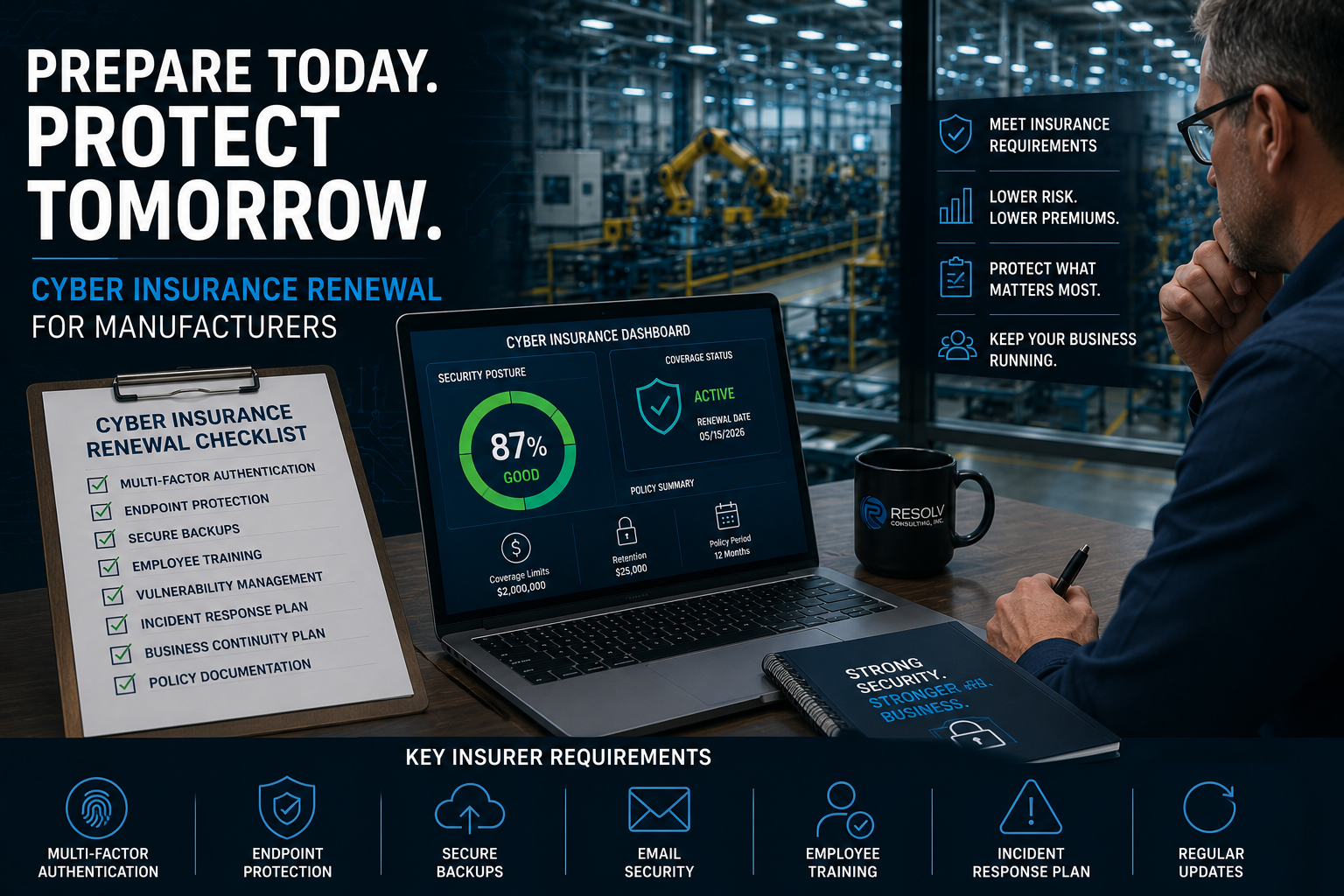
While every policy is different, many insurance providers now look for several foundational cybersecurity controls.
These commonly include:
- Multi-Factor Authentication (MFA)
- Endpoint Detection and Response (EDR)
- Advanced email security
- Secure backup solutions
- Security awareness training
- Vulnerability management
- Patch management
- Access control policies
- Incident response planning
- Business continuity planning
Organizations lacking these controls may experience higher premiums—or even difficulty obtaining coverage.
Questions to Ask Before Your Renewal
Before submitting your renewal application, manufacturers should review several important areas.
Ask yourself:
- Is Multi-Factor Authentication enabled for all users?
- Are backups tested regularly?
- Is Endpoint Detection and Response deployed across all devices?
- Do employees receive ongoing cybersecurity awareness training?
- Are privileged accounts properly secured?
- Has your incident response plan been updated?
- Are software updates applied consistently?
- Have recent vulnerability assessments been completed?
Being able to answer these questions confidently can simplify the renewal process.
Documentation Matters
Many insurers now request evidence that cybersecurity controls are actually being maintained.
Helpful documentation may include:
- Security policies
- Employee training records
- Backup testing reports
- Vulnerability assessment results
- Patch management reports
- Incident response documentation
- Business continuity plans
Keeping this information organized makes policy renewals significantly easier.
Cyber Insurance Doesn’t Replace Cybersecurity
One of the biggest misconceptions is that cyber insurance alone protects a business from cyber threats.
Insurance can help reduce financial losses following an incident, but it cannot prevent an attack.
Strong cybersecurity remains your first line of defense.
The most effective approach combines proactive cybersecurity, employee awareness, business continuity planning, and cyber insurance coverage.
How Managed IT Helps Manufacturers Prepare
Working with a Managed Service Provider can simplify cyber insurance renewals by ensuring essential security controls are properly implemented and maintained.
An experienced MSP can assist with:
- Security assessments
- Multi-Factor Authentication deployment
- Endpoint Detection and Response
- Backup verification
- Compliance documentation
- Continuous monitoring
- Security policy development
- Employee cybersecurity training
These services not only strengthen your cybersecurity but also improve your organization’s insurability.
Final Thoughts
Cyber insurance requirements continue to evolve as cyber threats become more sophisticated.
Manufacturers that prepare early, maintain strong cybersecurity practices, and document their security controls are better positioned to secure favorable coverage while protecting their operations from costly disruptions.
At Resolv Consulting, we help manufacturers throughout the Inland Empire and Greater Los Angeles strengthen cybersecurity, prepare for insurance renewals, and implement practical security strategies that support long-term business resilience.
Frequently Asked Questions
Why are cyber insurance companies asking more security questions?
Cyberattacks have become more frequent and expensive. Insurance providers now require stronger cybersecurity controls to reduce risk before issuing or renewing policies.
What cybersecurity controls are most commonly required?
Most insurers expect organizations to implement Multi-Factor Authentication, endpoint protection, secure backups, employee security awareness training, and incident response planning.
Can a Managed Service Provider help with cyber insurance renewals?
Yes. MSPs can help implement required cybersecurity controls, prepare documentation, conduct security assessments, and ensure your environment meets many common insurance requirements.
Does having cyber insurance mean my business is fully protected?
No. Cyber insurance provides financial protection after certain incidents, but it does not prevent cyberattacks. Strong cybersecurity remains essential for reducing overall business risk.
This blog is part of Resolv Consulting’s Manufacturing Cybersecurity Series, helping Southern California manufacturers strengthen cybersecurity, meet evolving insurance requirements, and build more resilient technology environments.