
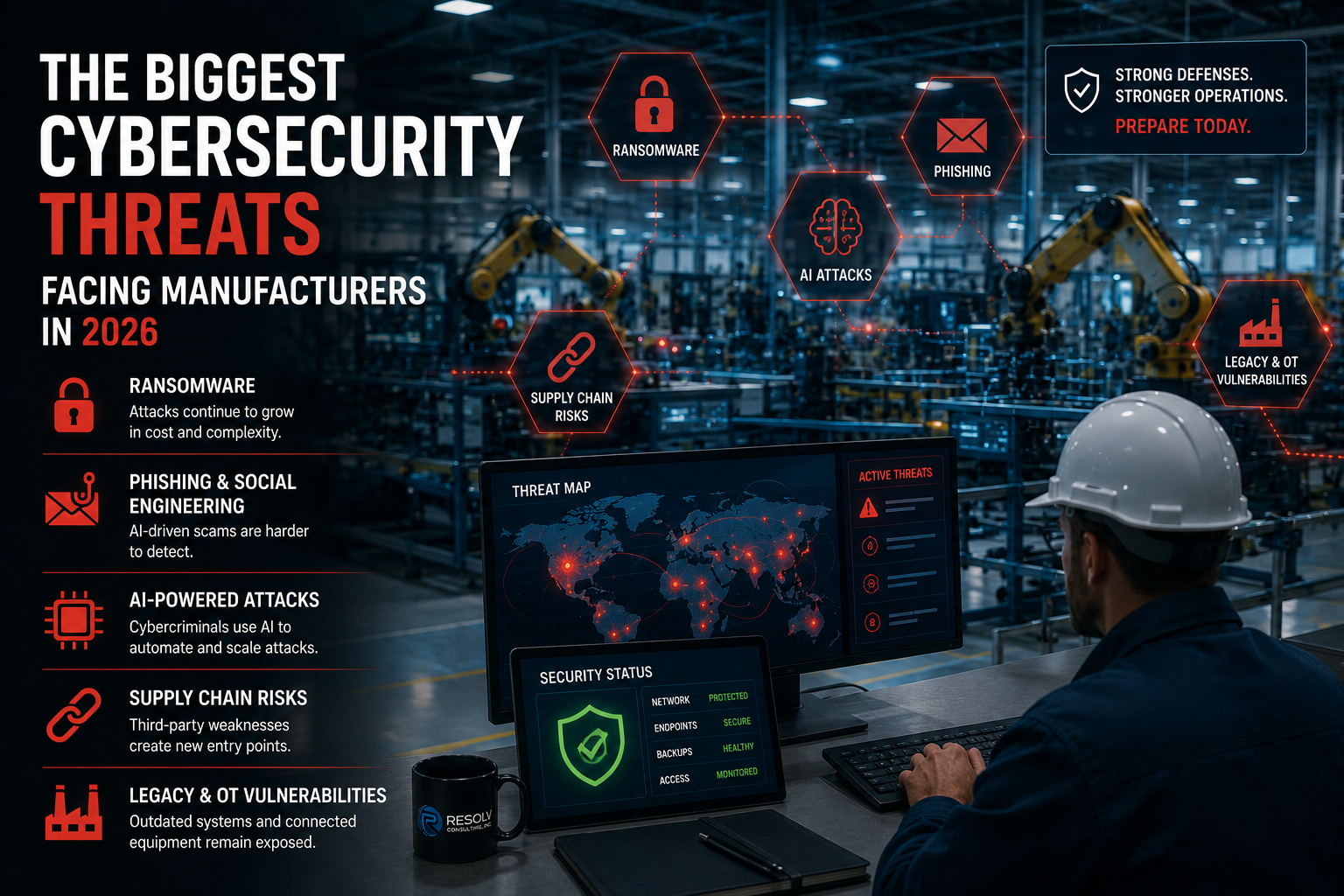
Manufacturers have become one of the most targeted industries for cybercriminals.
As factories become more connected through cloud platforms, Industrial Internet of Things (IIoT) devices, automation systems, and remote access technologies, cyber threats continue to evolve in both frequency and sophistication.
For manufacturers throughout Southern California, cybersecurity is no longer just about protecting computers—it’s about protecting production, customer relationships, intellectual property, and business continuity.
Understanding today’s most significant threats is the first step toward reducing risk.
- Ransomware Attacks Continue to Evolve
Ransomware remains one of the largest cybersecurity risks facing manufacturers.
Modern ransomware attacks don’t simply encrypt files.
Many attackers now:
- Steal sensitive company data
- Threaten to publish confidential information
- Target backups before encryption
- Shut down production systems
- Demand larger ransom payments
Because manufacturing downtime is extremely expensive, attackers often believe manufacturers are more likely to pay.
- AI-Powered Cyberattacks
Artificial intelligence has changed cybersecurity on both sides.
While AI helps improve threat detection, cybercriminals are also using AI to:
- Generate convincing phishing emails
- Automate password attacks
- Create realistic voice impersonations
- Produce fraudulent business communications
- Identify system vulnerabilities more quickly
Businesses should expect cyberattacks to become increasingly automated over the coming years.
- Supply Chain Cybersecurity Risks
Manufacturers rarely operate independently.
They rely on vendors, suppliers, logistics providers, software companies, and cloud platforms.
Unfortunately, every connected vendor creates another potential entry point for attackers.
Even if your own cybersecurity is strong, weaknesses within your supply chain can expose your organization to unnecessary risk.
Regular vendor security assessments are becoming increasingly important.
- Phishing and Social Engineering
Email continues to be one of the most effective ways for attackers to gain access to business networks.
Modern phishing attacks often appear highly legitimate.
Employees may receive emails that appear to come from:
- Customers
- Vendors
- Executives
- Banks
- Microsoft 365
- Shipping providers
Employee cybersecurity awareness training remains one of the most effective defenses against these attacks.
- Legacy Manufacturing Systems
Many manufacturers continue operating equipment that depends on outdated operating systems or unsupported software.
While replacing production equipment isn’t always practical, these legacy systems often contain security vulnerabilities that attackers actively target.
Protecting older technology requires network segmentation, access controls, monitoring, and layered cybersecurity strategies.
- Operational Technology (OT) Attacks
Operational Technology controls many manufacturing processes.
As OT environments become increasingly connected to traditional IT networks, attackers have new opportunities to disrupt production.
Securing OT environments requires specialized planning that balances cybersecurity with operational reliability.
How Manufacturers Can Reduce Cybersecurity Risk
No organization can eliminate cyber risk entirely, but manufacturers can significantly strengthen their defenses by implementing best practices.
These include:
- Multi-factor authentication
- Endpoint Detection and Response (EDR)
- Employee security awareness training
- 24/7 monitoring
- Regular vulnerability assessments
- Secure backup strategies
- Incident response planning
- Vendor risk management
- Network segmentation
- Routine software updates
Cybersecurity works best when multiple layers of protection work together.
Final Thoughts
Cyber threats will continue to evolve throughout 2026 and beyond.
Manufacturers that proactively invest in cybersecurity are better positioned to protect production, maintain customer trust, and reduce costly downtime.
At Resolv Consulting, we help manufacturers across the Inland Empire and Greater Los Angeles strengthen cybersecurity through proactive monitoring, advanced threat protection, risk assessments, and strategic IT planning. By staying ahead of emerging threats, businesses can focus on growth with greater confidence.
Frequently Asked Questions
Why are manufacturers increasingly targeted by cybercriminals?
Manufacturers rely on interconnected production systems, valuable intellectual property, and time-sensitive operations. These factors make them attractive targets for ransomware and other cyberattacks.
What is the biggest cybersecurity threat facing manufacturers today?
Ransomware remains one of the most significant threats, but AI-powered phishing, supply chain attacks, and vulnerabilities in legacy systems are rapidly growing concerns.
How can manufacturers improve cybersecurity?
Implementing layered security controls such as multi-factor authentication, endpoint detection, employee training, secure backups, and continuous monitoring significantly reduces cyber risk.
Does cybersecurity require replacing older manufacturing equipment?
Not necessarily. Many legacy systems can be protected using network segmentation, access controls, monitoring, and other compensating security measures until upgrades become practical.
This blog is part of Resolv Consulting’s Manufacturing Cybersecurity Series, providing practical guidance to help Southern California manufacturers defend against evolving cyber threats while improving operational resilience and business continuity.