
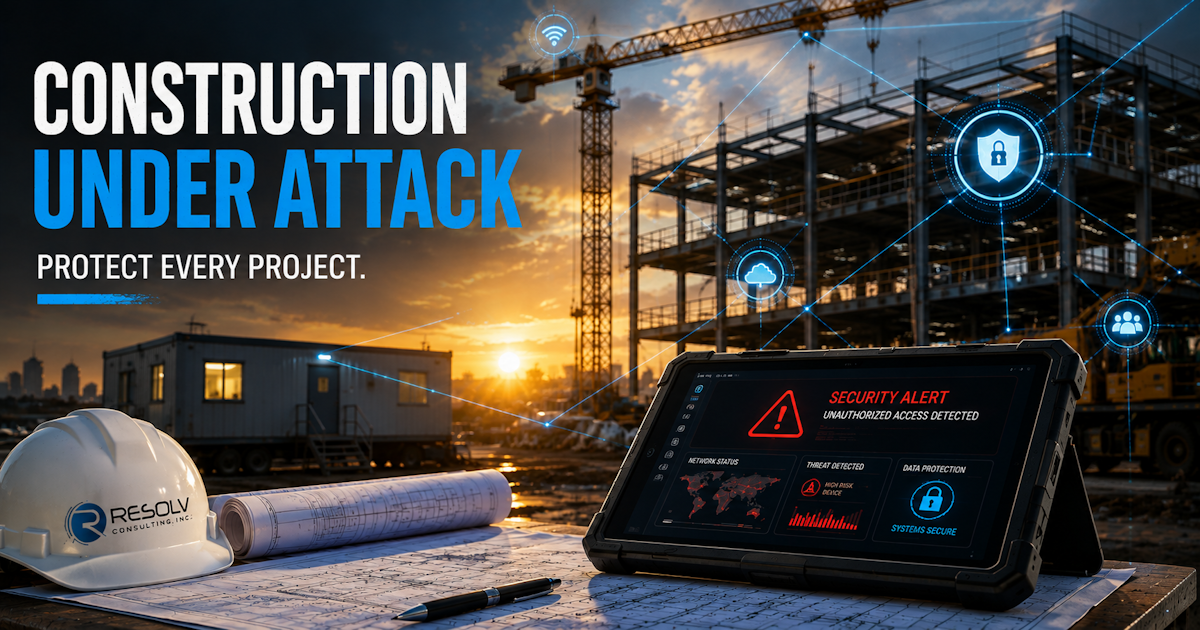
Cybercriminals are no longer focused only on large corporations or financial institutions.
Today, construction companies of all sizes have become attractive targets because they manage valuable financial information, confidential project documents, and complex networks of employees, subcontractors, vendors, and clients.
As technology becomes more integrated into construction operations, cybersecurity is no longer optional—it’s a critical part of protecting your projects, your reputation, and your bottom line.
For contractors throughout Southern California, understanding today’s cyber risks is the first step toward preventing costly disruptions.
Why Construction Companies Are Attractive Targets
Construction projects involve constant communication between multiple organizations.
General contractors regularly exchange:
- Architectural drawings
- Engineering documents
- Contracts
- Bid information
- Payment requests
- Banking details
- Change orders
- Vendor invoices
- Client communications
This creates multiple opportunities for cybercriminals to intercept information or impersonate trusted contacts.
Business Email Compromise Is Growing
One of the fastest-growing threats affecting contractors is Business Email Compromise (BEC).
Attackers often monitor email conversations before sending realistic-looking payment requests or fraudulent wire instructions.
Without proper verification procedures, companies can unknowingly send large payments directly to criminals.
Construction firms are especially vulnerable because wire transfers and vendor payments occur frequently throughout every project.
Ransomware Can Stop a Project Overnight
Ransomware remains one of the most damaging cyber threats facing construction companies.
A successful attack can encrypt:
- Project files
- Accounting systems
- Scheduling software
- Microsoft 365 data
- Shared network drives
- Backup systems
When employees lose access to critical information, projects may slow down or stop entirely until systems are restored.
Mobile Workforces Increase Risk
Construction teams rarely work from a single office.
Project managers, superintendents, estimators, and executives regularly access company systems from:
- Jobsites
- Home offices
- Hotels
- Client locations
- Mobile devices
While remote access improves productivity, it also creates additional opportunities for cybercriminals if devices are not properly secured.
Third-Party Vendors Expand the Attack Surface
General contractors depend on dozens—or even hundreds—of subcontractors and vendors throughout the life of a project.
Each external relationship introduces additional cybersecurity considerations.
Weak security practices at one organization can potentially expose sensitive information across multiple project partners.
Managing vendor access has become an important part of overall construction cybersecurity.
Common Cybersecurity Best Practices
Construction companies can significantly reduce cyber risk by implementing practical security measures.
These include:
- Multi-Factor Authentication (MFA)
- Endpoint Detection and Response (EDR)
- Security awareness training
- Regular software updates
- Secure cloud backups
- Email security protection
- Network monitoring
- Strong password policies
- Vendor access controls
Cybersecurity is most effective when these protections work together as part of a layered strategy.
How Managed IT Supports Construction Companies
An experienced Managed Service Provider helps contractors protect both office and field operations.
Managed IT Services can provide:
- 24/7 monitoring
- Microsoft 365 security
- Endpoint protection
- Backup and disaster recovery
- Security awareness training
- Compliance support
- Mobile device management
- Incident response planning
This proactive approach helps reduce downtime while improving overall cybersecurity resilience.
Final Thoughts
Construction companies face increasingly sophisticated cyber threats, but proactive planning can significantly reduce risk.
By combining modern cybersecurity tools, employee training, and ongoing technology management, contractors can better protect sensitive information, maintain project continuity, and strengthen client confidence.
At Resolv Consulting, we help construction companies throughout the Inland Empire and Greater Los Angeles implement cybersecurity strategies designed to protect project data, secure mobile workforces, and keep construction projects moving forward.
Frequently Asked Questions
Why are construction companies targeted by cybercriminals?
Construction companies manage valuable financial transactions, confidential project documents, and large networks of subcontractors and vendors, making them attractive targets for cyberattacks.
What is the biggest cybersecurity threat to contractors?
Business Email Compromise, ransomware, phishing attacks, and unauthorized remote access remain among the most common threats facing today’s construction companies.
How can contractors improve cybersecurity?
Organizations should implement Multi-Factor Authentication, endpoint protection, employee security awareness training, secure backups, network monitoring, and strong access controls.
Can Managed IT Services help protect construction companies?
Yes. Managed IT providers help contractors strengthen cybersecurity, monitor systems, secure Microsoft 365 environments, protect remote workers, and respond quickly to security incidents.
This blog is part of Resolv Consulting’s Construction Technology Series, helping general contractors and construction companies throughout Southern California strengthen cybersecurity, protect project data, and build more resilient technology environments.