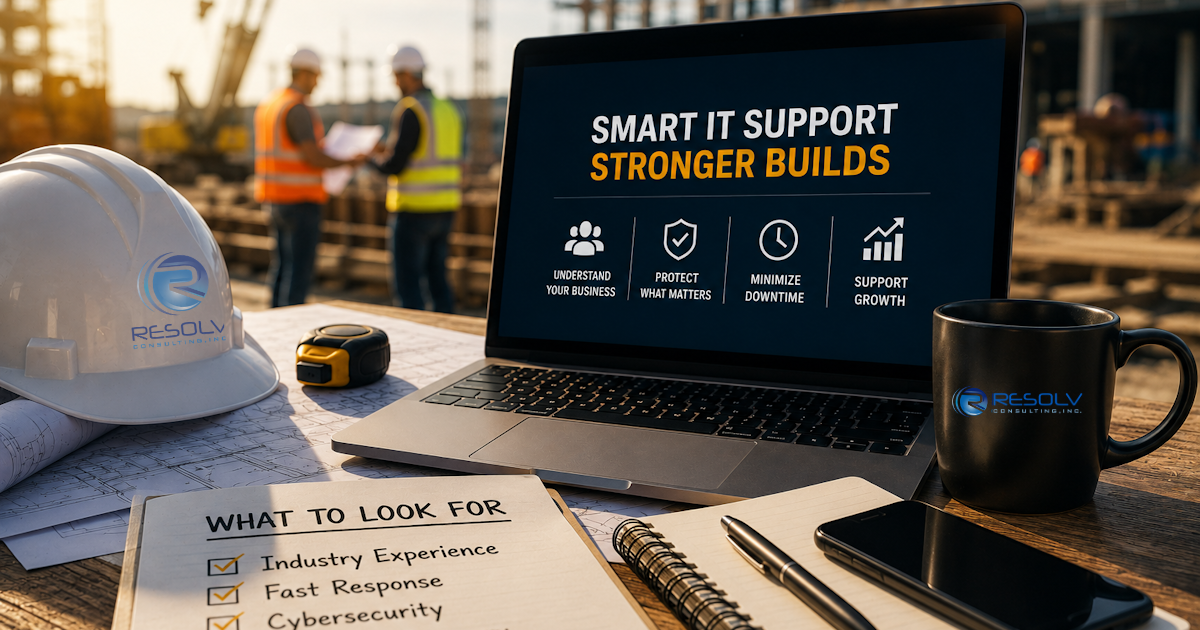
Technology has become essential to construction.
Project managers rely on cloud applications. Superintendents access plans from jobsites. Accounting teams process invoices electronically. Executives communicate with employees, clients, vendors, and subcontractors from virtually anywhere.
When everything works, technology makes the business more efficient.
When something goes wrong, the impact can reach far beyond the office.
A network outage can interrupt communication.
A cybersecurity incident can compromise sensitive information.
A problem with a critical application can prevent employees from accessing the information they need.
That’s why choosing the right IT support company is an important business decision for a construction company.
The right IT partner should understand more than technology. They should understand how your construction business actually operates.
Construction IT Isn’t the Same as Traditional Office IT
A construction company has technology requirements that can be very different from a typical office-based business.
Your employees may work from:
- Corporate offices
- Jobsites
- Home offices
- Client locations
- Temporary project offices
- Vehicles and other mobile environments
Your IT provider needs to understand how these environments connect.
A solution that works perfectly in an office may not necessarily work as well for a superintendent working from a jobsite.
Look for an IT Partner Who Understands Your Industry
One of the first questions to ask a potential IT provider is:
Do you understand construction?
Your provider should be familiar with the technology construction companies commonly depend on, including:
- Construction management platforms
- Microsoft 365
- Digital plan and document systems
- Accounting software
- Mobile devices
- Jobsite networks
- Cloud applications
- File sharing
- Remote access
Industry experience can help an IT provider identify potential problems before they become major disruptions.
Proactive Support Is Better Than Waiting for Something to Break
Traditional IT support can be reactive.
Something stops working, someone calls, and the problem gets fixed.
That’s useful—but it’s not enough for a growing construction company.
A proactive IT strategy focuses on identifying and addressing problems before they affect employees.
This may include:
- Network monitoring
- Device monitoring
- Security updates
- Software patching
- Backup monitoring
- Security alerts
- Account management
- Technology planning
The goal is to reduce preventable problems instead of constantly reacting to them.
Response Time Matters
When technology stops working, employees shouldn’t have to wait days for help.
Ask potential IT providers:
How quickly can we get support?
Who do we contact when there’s an urgent problem?
Is support available outside normal business hours?
How are critical issues escalated?
These questions become even more important when employees are working on active projects with deadlines that can’t simply be moved.
Your IT Provider Should Understand Your Jobsites
Construction technology doesn’t stop at the office door.
Jobsites may depend on:
- Wi-Fi
- Cellular connectivity
- Tablets
- Laptops
- Cloud applications
- Cameras
- Communication systems
- Network equipment
A good IT partner should understand how to support technology in environments where conditions can change quickly.
Jobsite connectivity also needs to be secure.
Convenience shouldn’t come at the expense of cybersecurity.
Cybersecurity Should Be Built Into Your IT Strategy
Cybersecurity shouldn’t be treated as an optional add-on.
Your IT provider should help protect the systems employees use every day.
That may include:
- Multi-Factor Authentication
- Endpoint protection
- Email security
- Security awareness training
- User access controls
- Network security
- Monitoring
- Backup protection
The specific tools will vary from company to company.
What’s important is having a layered strategy designed around your actual business environment.
Ask About Backup and Recovery
Your IT provider should be able to explain exactly how your critical information is protected.
Ask:
What is being backed up?
How often is it backed up?
Where is it stored?
How long is it retained?
Is it protected from ransomware?
How quickly could we recover?
And perhaps most importantly:
When was the last successful recovery test?
You shouldn’t have to discover the answers after a disaster occurs.
Your IT Provider Should Help You Plan for Growth
The technology that works for a 10-person company may not be the right solution for a 50-person or 100-person company.
As construction companies grow, they may add:
- Employees
- Jobsites
- Devices
- Software
- Cloud applications
- Locations
- Clients
- Subcontractors
Your IT environment needs to grow with the business.
A strong IT partner should help identify what technology changes may be needed before growth creates unnecessary problems.
Communication Is Part of Good IT Support
Technical expertise is important.
So is communication.
When something goes wrong, you shouldn’t need to understand complicated technical terminology to know what’s happening.
A good IT provider should be able to explain:
- What happened
- What is being done
- What employees need to know
- How long resolution may take
- What can be done to prevent the issue from happening again
You should feel like your IT provider is working with your business—not simply working on your computers.
Look for Strategic Guidance, Not Just Help Desk Support
A strong IT relationship should go beyond fixing individual problems.
Your IT provider should be able to help you answer questions such as:
Are we protected against current cybersecurity threats?
Is our backup strategy adequate?
Are our employees accessing technology securely?
Are our systems ready for growth?
Where are our biggest technology risks?
What should we prioritize next?
This type of strategic guidance can help construction companies make better technology decisions over time.
Questions to Ask Before Choosing an IT Provider
Before selecting an IT company, consider asking:
- Do you have experience supporting construction companies?
- Can you support both office and jobsite environments?
- What cybersecurity services do you provide?
- How quickly do you respond to critical issues?
- How do you monitor and maintain our systems?
- How are our backups protected?
- How do you support Microsoft 365?
- Can you help with technology planning?
- How do you handle employee onboarding and offboarding?
- Who will be responsible for our account?
The answers can reveal a lot about whether an IT provider is actually equipped to support your business.
Red Flags to Watch For
Not every IT provider is a good fit for construction.
Be cautious if a provider:
- Only reacts after something breaks
- Can’t explain its cybersecurity strategy
- Doesn’t regularly monitor backups
- Has no clear escalation process
- Doesn’t understand jobsite technology
- Can’t provide strategic guidance
- Uses excessive technical jargon without explanation
- Treats every client exactly the same
Your construction business has specific needs.
Your IT strategy should reflect them.
How Resolv Consulting Can Help
At Resolv Consulting, we understand that construction companies need technology that works across both the office and the jobsite.
Our approach focuses on helping businesses maintain reliable, secure, and manageable technology environments through services such as:
- Managed IT Services
- Cybersecurity
- Microsoft 365 support
- Backup and disaster recovery
- Network management
- Technology consulting
- Ongoing IT support
For construction companies throughout Southern California, the goal is simple:
Keep your people productive, your information protected, and your projects moving.
Final Thoughts
Choosing an IT provider isn’t simply about finding someone who can fix a computer.
It’s about finding a technology partner who understands your business and can help you prepare for what comes next.
Construction companies need an IT strategy that accounts for employees in the office, workers in the field, multiple jobsites, cloud applications, cybersecurity threats, and the constant pressure to keep projects moving.
The right IT partner can help turn technology from a source of frustration into a competitive advantage.
Your IT provider should understand your technology. More importantly, they should understand your business.
Frequently Asked Questions
What should construction companies look for in an IT support company?
Construction companies should look for an IT provider with experience supporting construction businesses, proactive monitoring, cybersecurity expertise, backup and recovery capabilities, responsive support, and an understanding of both office and jobsite technology.
How much does IT support cost for a construction company?
IT support costs vary depending on company size, number of employees, locations, devices, applications, cybersecurity requirements, and level of support needed. A customized assessment is generally the best way to determine the appropriate solution.
Why does construction industry experience matter for IT support?
Construction companies have unique technology requirements because employees frequently work between offices, jobsites, and remote locations. Industry experience can help an IT provider better understand those operational and technology challenges.
Should construction companies use Managed IT Services?
Managed IT Services can provide proactive monitoring, maintenance, cybersecurity, help desk support, backup management, and technology guidance without requiring a construction company to manage every aspect of its IT environment internally.
Can an IT company support construction jobsites?
Yes. A qualified construction IT provider can help support jobsite connectivity, mobile devices, cloud applications, security, remote access, and communication between field teams and the main office.
This blog is part of Resolv Consulting’s Construction & General Contracting Technology Series, helping construction companies throughout Southern California make better technology decisions, reduce IT-related disruptions, and build secure technology environments that support their projects and growth.