
Construction companies have a lot to protect.
Project plans.
Contracts.
Financial information.
Employee records.
Client information.
Vendor communications.
Schedules.
And the systems employees use to keep projects moving.
The challenge is that much of this information is no longer kept in one office.
Employees may access it from jobsites, home offices, mobile devices, cloud applications, and client locations.
That flexibility is important for construction companies.
It also creates more opportunities for something to go wrong.
Construction cybersecurity isn’t just about protecting computers. It’s about protecting the information and systems your company depends on to operate.
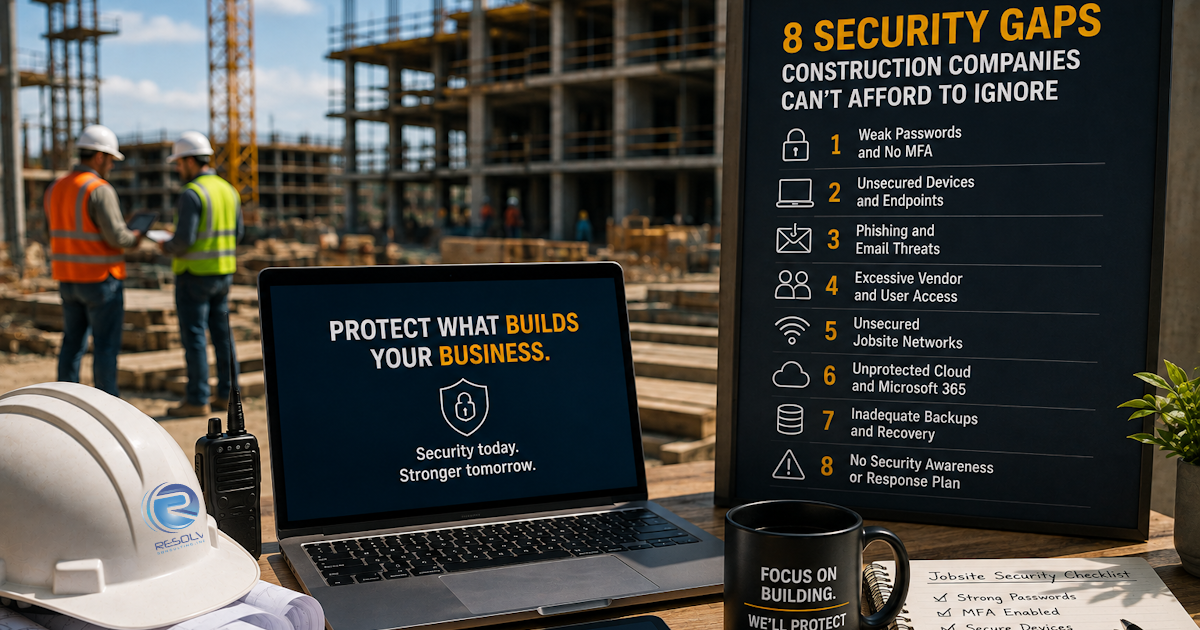
Here are eight security gaps every general contractor should evaluate.
- Too Many Employees Rely on Passwords Alone
Passwords are still a major part of how employees access business systems.
The problem is that a password by itself provides limited protection if it is stolen, guessed, or reused.
Construction employees may have access to:
- Microsoft 365
- Project management systems
- Accounting software
- File storage
- Customer information
- Vendor portals
One compromised account can potentially provide access to multiple business resources.
What should construction companies do?
Multi-Factor Authentication should be enabled wherever practical, particularly for systems containing sensitive business information.
MFA adds another layer of protection beyond the password.
It’s a relatively simple security improvement that can make unauthorized account access significantly more difficult.
- Employees Access Company Information From Unsecured Devices
Construction doesn’t happen behind a desk.
Project managers, superintendents, estimators, executives, and other employees may move between offices, jobsites, homes, meetings, and other locations.
That means company information may be accessed from laptops, smartphones, tablets, and other devices.
The security question isn’t simply:
“Can employees access the system?”
It’s:
“Can they access it securely?”
Companies should consider:
- Device encryption
- Endpoint protection
- Security updates
- Mobile device management
- Strong authentication
- Remote access controls
- Device monitoring
A lost laptop or phone shouldn’t automatically become a data-security emergency.
- Your Email May Be an Easy Target
Email remains one of the most important communication tools in construction.
Employees use it to communicate with:
- Clients
- Subcontractors
- Vendors
- Architects
- Engineers
- Project managers
- Accounting teams
That makes email an important part of a construction company’s cybersecurity strategy.
A convincing phishing message can appear to come from someone an employee knows.
It may request:
- Payment information
- Login credentials
- Sensitive documents
- Wire transfers
- Password resets
- Other confidential information
Technical security controls matter.
So does employee awareness.
Your employees are part of your cybersecurity strategy.
Regular security awareness training can help employees recognize suspicious messages before they become costly problems.
- Vendor and Subcontractor Access Isn’t Always Reviewed
Construction projects involve a lot of outside organizations.
General contractors may work with:
- Subcontractors
- Vendors
- Architects
- Engineers
- Consultants
- Clients
- Temporary workers
These relationships can require information sharing.
But access should still be managed carefully.
A simple question worth asking is:
Who has access to our information right now, and why?
Companies should regularly review:
- User accounts
- Shared accounts
- Permissions
- Former employees
- Vendor access
- Third-party applications
- File-sharing permissions
Not everyone needs access to everything.
Giving users the access they actually need—and removing access when they no longer need it—is an important part of protecting company information.
- Jobsite Technology May Not Be Properly Secured
A construction jobsite isn’t a traditional office.
Technology may be temporary.
Internet connectivity may change.
Devices may move between locations.
Multiple people may need access to project systems.
That makes jobsite technology worth including in your cybersecurity planning.
Consider:
- Jobsite Wi-Fi
- Network equipment
- Mobile devices
- Wireless access
- Remote connections
- Cloud applications
- Shared devices
A secure jobsite isn’t necessarily the most complicated jobsite.
It is one where connectivity and security have been planned together.
- Microsoft 365 and Cloud Accounts Need Ongoing Protection
Moving information to the cloud doesn’t eliminate cybersecurity responsibilities.
Construction companies may rely heavily on cloud-based email, document storage, collaboration tools, and business applications.
Those environments still need:
- Strong authentication
- Appropriate permissions
- Security monitoring
- Backup and recovery planning
- Account management
- Regular security reviews
One of the biggest mistakes businesses can make is assuming:
“It’s in the cloud, so it’s automatically protected.”
Cloud services can provide important security capabilities.
But businesses still need to properly configure, manage, and protect their accounts.
- Backups May Exist Without a Real Recovery Strategy
A construction company can have backups and still be unprepared for a serious incident.
The important question isn’t:
“Do we have backups?”
It’s:
“Can we actually recover what we need, when we need it?”
Your IT team or MSP should be able to answer:
- What information is backed up?
- How often is it backed up?
- Where is it stored?
- Is it protected from unauthorized access?
- How long is it retained?
- Has restoration been tested?
- Which systems would be restored first?
Construction projects depend on information.
If project documents, financial systems, email, or other critical applications become unavailable, recovery needs to be more than a theoretical plan.
- Your Company May Not Know Where Its Biggest Security Gaps Are
This may be the biggest gap of all.
Many businesses know cybersecurity is important.
But knowing that isn’t the same as knowing where your vulnerabilities actually are.
A construction company should periodically evaluate:
People
Who has access to company systems?
Devices
Are laptops, phones, and tablets properly protected?
Applications
Are business applications configured securely?
Data
Where is important company information stored?
Access
Who can access sensitive information?
Backups
Can critical information actually be recovered?
Network
Are office and jobsite connections properly secured?
Response
Does everyone know what to do if something goes wrong?
You can’t fix what you haven’t identified.
Construction Cybersecurity Isn’t a One-Time Project
One of the biggest misconceptions about cybersecurity is that you can simply install security software and consider the problem solved.
Cybersecurity changes because businesses change.
Employees join and leave.
New devices are added.
Projects start and finish.
New software gets introduced.
Cloud applications change.
Vendors change.
Threats change.
Your security strategy needs to change with them.
That’s why proactive monitoring, regular reviews, employee training, and ongoing technology management matter.
What Should a Construction Cybersecurity Strategy Include?
There isn’t one security package that works for every contractor.
However, a strong foundation may include:
- Multi-Factor Authentication
- Endpoint protection
- Email security
- Security awareness training
- Secure backups
- Mobile device management
- Access controls
- Network security
- Patch management
- Monitoring
- Incident response planning
- Regular security assessments
The right combination depends on the company’s size, technology environment, project requirements, and risk profile.
Why Construction Companies Should Take Cybersecurity Seriously
Construction companies depend on technology throughout the project lifecycle.
A technology problem can affect:
- Communication
- Project documentation
- Scheduling
- Accounting
- Estimating
- Field operations
- Client communication
- Vendor relationships
The cost of cybersecurity isn’t simply the cost of recovering a compromised computer.
The larger concern is what happens to the business operation when the information people need suddenly isn’t available.
That’s why cybersecurity should be treated as part of business continuity—not simply an IT expense.
What Should a General Contractor Ask Its IT Provider?
If you’re evaluating your current IT provider, ask these questions:
- Are all of our important accounts protected with MFA?
- How are our laptops and mobile devices protected?
- How are our Microsoft 365 accounts monitored?
- Who currently has access to our sensitive information?
- How often are user permissions reviewed?
- Are our backups monitored and tested?
- How are our jobsites secured?
- What happens if an employee loses a device?
- What happens if an employee clicks on a phishing email?
- What happens if our systems are unavailable tomorrow?
If your provider can’t clearly answer those questions, it may be time for a more complete technology and cybersecurity assessment.
Construction Cybersecurity in Southern California
For construction companies throughout the Inland Empire and Greater Los Angeles, technology often has to support both office operations and employees working across active projects.
That makes cybersecurity particularly important for businesses that need employees to access information from multiple locations.
A strong strategy should account for the entire environment—not just the computers sitting in the main office.
At Resolv Consulting, our approach is centered around proactive IT management, cybersecurity, backup and recovery, and responsive support. Our goal is to understand how a client’s business operates and build technology solutions around those needs rather than simply selling more technology.
How Resolv Consulting Can Help
Resolv Consulting provides Managed IT Services, cybersecurity, backup and disaster recovery, and Co-Managed IT solutions for businesses throughout Los Angeles, San Bernardino, Orange, and Riverside Counties.
Our team works with businesses to manage the technology they depend on while helping identify and address security and reliability gaps.
For construction companies, that means helping protect the systems connecting the office, field teams, cloud applications, and business information.
The goal isn’t to make technology complicated.
It’s to make your technology reliable, secure, and easier to manage.
Final Thoughts
Construction cybersecurity doesn’t have to be overwhelming.
Start with the basics.
Protect your accounts.
Secure your devices.
Train your employees.
Review vendor access.
Protect your backups.
Secure your cloud systems.
Monitor your environment.
And know what you would do if something went wrong.
The best cybersecurity strategy isn’t the one with the most technology.
It’s the one that protects the systems your business actually depends on.
Frequently Asked Questions
What is construction cybersecurity?
Construction cybersecurity is the practice of protecting a construction company’s computers, mobile devices, networks, cloud applications, project information, employee accounts, and business data from unauthorized access, cyberattacks, and other security threats.
Why is cybersecurity important for general contractors?
General contractors rely on technology for project management, communication, accounting, document sharing, scheduling, and field operations. A security incident can disrupt those systems and affect productivity and project operations.
What are the biggest cybersecurity risks for construction companies?
Common areas of concern include compromised email accounts, weak passwords, unsecured mobile devices, excessive user permissions, phishing attacks, unsecured jobsite networks, poorly protected cloud accounts, and inadequate backup or recovery processes.
Should construction companies use Multi-Factor Authentication?
Yes. MFA adds another layer of protection beyond a password and should be used for important business accounts whenever practical.
How can construction companies protect jobsite devices?
Companies can use tools and policies such as device encryption, endpoint protection, Mobile Device Management, MFA, access controls, security updates, and employee security training.
Are cloud applications automatically secure?
No. Cloud platforms can provide strong security features, but businesses still need to configure and manage accounts, permissions, authentication, backups, and other security controls properly.
How often should a construction company review cybersecurity?
Cybersecurity should be reviewed regularly and whenever there are significant changes to employees, devices, applications, projects, vendors, or business operations.
Can an MSP help with construction cybersecurity?
Yes. An MSP can help construction companies implement and manage cybersecurity controls, monitor systems, protect devices, manage accounts, secure backups, train employees, and develop a more proactive security strategy.
This blog is part of Resolv Consulting’s Construction & General Contracting Technology Series, helping construction companies throughout Southern California understand how proactive IT management and cybersecurity can protect the technology their projects depend on.